Europe Blames Muslims for Its Problems, Sparking New Parliamentary Resolution
By Farid Hafez, senior researcher with Georgetown University’s The Bridge Initiative
Published 21 Oct 2026
Recent unrest in France has seen the far‑right quickly resort to racist rhetoric, blaming Muslim youth for violent protests. A similar pattern emerged weeks earlier when thousands of migrants tried to enter the Spanish enclave of Ceuta from Morocco, prompting Spain’s far‑right to describe it as an organised “invasion” by Moroccans. Even former U.S. President Donald Trump entered the fray, claiming the issue reflects “Islam wanting to take over.”
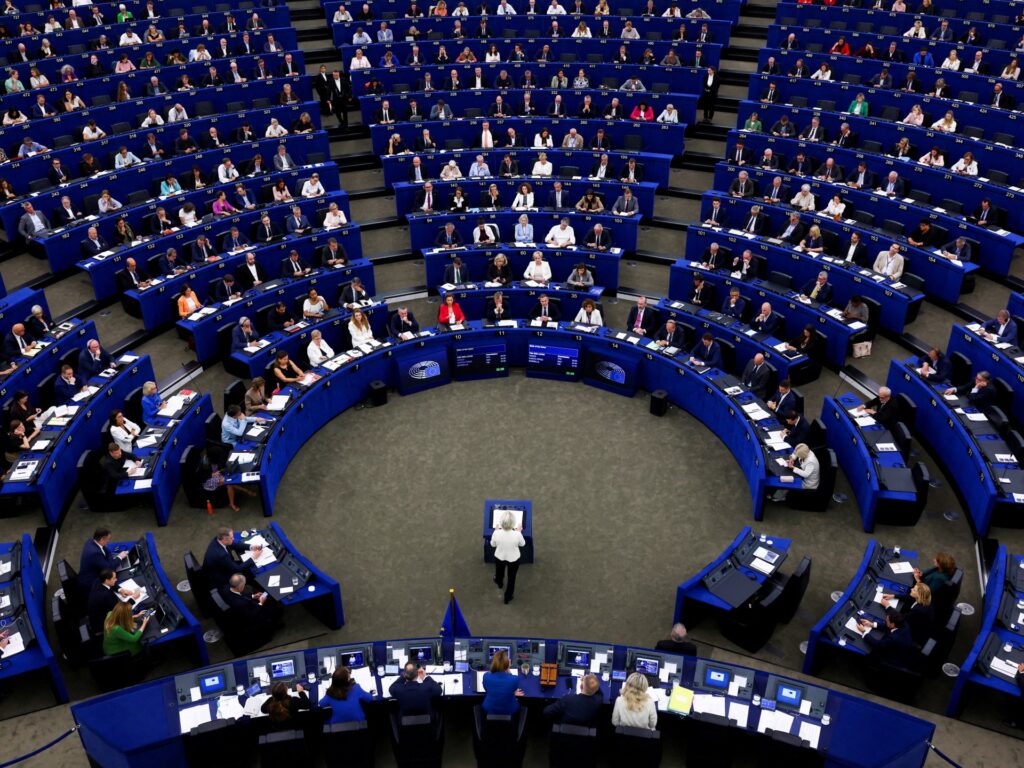
While such exploitation of crises by extremist groups is expected, the notion that Islam and Muslims are responsible for Europe’s growing challenges is no longer confined to the fringe. Last week, as student demonstrations intensified in France, the European Parliament passed a resolution titled “on the need for an EU strategy to counter Islamist entryism and the influence of the Muslim Brotherhood network.” The text was introduced by the centre‑right European People’s Party (EPP), the parliament’s largest group and the party of European Commission President Ursula von der Leyen.
The vote recorded 381 in favour, 167 against and 15 abstentions. Four other groups supported the EPP almost unanimously: the far‑right Patriots for Europe and Europe of Sovereign Nations, the liberal Renew Europe, and the European Conservatives and Reformists. The Social Democrats, the Left and the Greens largely opposed the measure but could not block it.
The resolution draws on a controversial French government report on “political Islamism” and makes a series of questionable claims with far‑reaching consequences for Muslim communities. It defines “Islamist entryism” as a political strategy involving influence, institutional penetration and ideological legitimation. It alleges that “Islamist influence operates through a broad and fragmented ecosystem of associations, foundations and cultural, educational, religious, charitable, university, youth, anti‑discrimination or social action structures.” The text further suggests that diversity, equity, inclusion and anti‑discrimination frameworks can be co‑opted to legitimize a politicised religious identity, implying that networks such as the Muslim Brotherhood infiltrate European societies via anti‑Islamophobia initiatives.
Although the resolution is not binding and EU member states are not required to act on it, its call to place the Muslim Brotherhood and related individuals on a terror list is unlikely to be adopted, given the movement’s public renunciation of violence. Nevertheless, the measure lends credibility to an ideological framework that could harm Muslim communities. It casts suspicion on independent Muslim institutions and frames participation in civil society as a form of infiltration.
The resolution specifically names organisations such as the Brussels‑based European Network Against Racism (ENAR) as engaging in “Islamist” behaviour, and proposes cutting off EU funding to any entity that collaborates with them. The vague reference to a “Muslim Brotherhood network” opens the door to guilt by association for a wide range of actors.
External actors have already begun to exploit this language. The United Arab Emirates, for example, has financed a broad campaign across Europe to label individuals and groups as Muslim Brotherhood affiliates. An Emirati ambassador attended a European Parliament conference titled “Muslim Brotherhood: A real threat to Europe” just months before the resolution was introduced. The document also raises concerns about “foreign funding” from Qatar or Turkey that allegedly supports “Islamist entryism,” hinting at deeper geopolitical maneuvering.
Most troubling, the resolution frames efforts to combat racism against Muslims as part of an Islamist infiltration plot. This stance could undermine initiatives and public debates aimed at addressing Islamophobia in European societies.
Symbolically, the resolution marks a significant win for Europe’s right‑wing anti‑Muslim forces. It signals that the European Parliament is lowering its guard against far‑right influence as the centre‑right draws ever closer to extremist positions. The EPP appears to have absorbed much of the far‑right agenda, repackaging it in national‑security language.
The nature of European Islamophobia is also shifting. The fear is no longer directed solely at immigrant “others” who might not integrate, but at Muslims who are vocal in defending their civil liberties. For centre‑right parties, this Islamophobic narrative offers electoral benefits and a tool to attack left‑wing groups that champion anti‑racist causes.
The concept of “Islamo‑leftism,” known in French as “Islamo‑gauchisme,” is gaining traction in French politics. Figures such as Jean‑Luc Mélenchon of La France Insoumise, who enjoys strong support among marginalized communities, are being portrayed as part of this alleged threat.