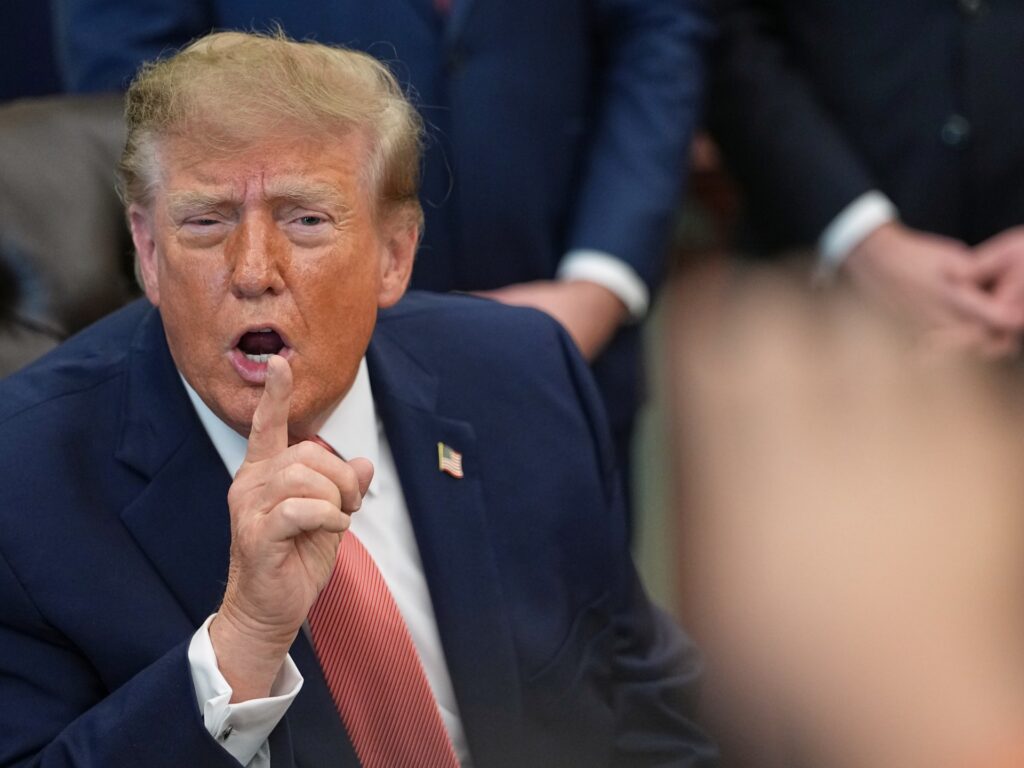
Trump urges Ukraine to accept peace deal, says he doesn’t care how it’s achieved
President Donald Trump intensified pressure on Kyiv on Tuesday, insisting that Ukrainian President Volodymyr Zelenskyy must be willing to negotiate an end to the war with Russia. Speaking from the White House, Trump blamed Zelenskyy for delaying peace, warning that the situation could become “a very bad thing” if the Ukrainian leader does not want to settle the conflict.
Trump recalled a February 2025 Oval Office meeting with Zelenskyy, saying the Ukrainian president could have secured a “better deal” at that time. “He’s going to have to want to make a deal, because I don’t think his people are going to stand for it any longer,” the president told reporters.
Later that day Zelenskyy met U.S. special envoy Steve Witkoff and European officials in Oslo to discuss a possible resolution. In a social‑media post after the talks, Zelenskyy said his country has “some clear ideas on how to get to peace,” adding that “we are united with our European partners in this effort, and we want the Americans to take these ideas to the Russians.” He suggested a trilateral summit of leaders to address issues only heads of state can resolve, and noted that Witkoff would travel to Moscow on Wednesday for further discussions. “Let’s see what Putin has to say,” Zelenskyy wrote.
When asked whether Zelenskyy should meet Russian President Vladimir Putin, Trump said the animosity between them was “tremendous” and that “it’s hard for them to be in the same room,” but added, “I don’t care how it’s done.”
The president’s comments come amid reports that the United States has limited Ukraine’s access to Starshield, the military‑grade version of SpaceX’s Starlink system. Ukraine depends on the satellite network for communications and intelligence to counter Russian attacks. SpaceX CEO Elon Musk, a Trump ally, attributed the restrictions to the White House, tweeting, “Starshield systems are owned and controlled by the US government. Any limits on speed or usage are decided by the US military and ultimately POTUS.” Reuters cited two U.S. officials and a Western source saying the order originated inside the White House, while a Wall Street Journal report claimed Musk himself ordered the slowdown. Both Trump and Defense Secretary Pete Hegseth denied that the administration directed the limits, with Hegseth shifting responsibility to SpaceX.
Trump has also been working to thaw relations with Moscow. In August 2025 he invited Putin to Alaska, marking the Russian leader’s first visit to U.S. soil in a decade. This month the president expressed openness to a trilateral meeting with Putin and Chinese President Xi Jinping on denuclearisation, and announced a deal to purchase diesel from Russia, reversing years of U.S. pressure on the Russian economy. He also waived new sanctions that would have been triggered by the Lindsey Graham Sanctioning Russia and Iran Act, a bipartisan law he signed a month earlier in memory of a late senator. The act would have targeted Russian officials, banks, tankers and imposed tariffs on nations buying Russian oil.
Secretary of State Marco Rubio defended the waiver, explaining that the legislation contains a provision allowing a national‑security exemption. “The president chose to use a national security waiver to not immediately implement those sanctions and restrictions, because he recognises that these things have to be looked at in their totality,” Rubio told India’s News18. He added that economic pressure can sometimes spill over and harm other countries, describing the administration’s approach as a “balancing act” between sanctions and global impacts.