
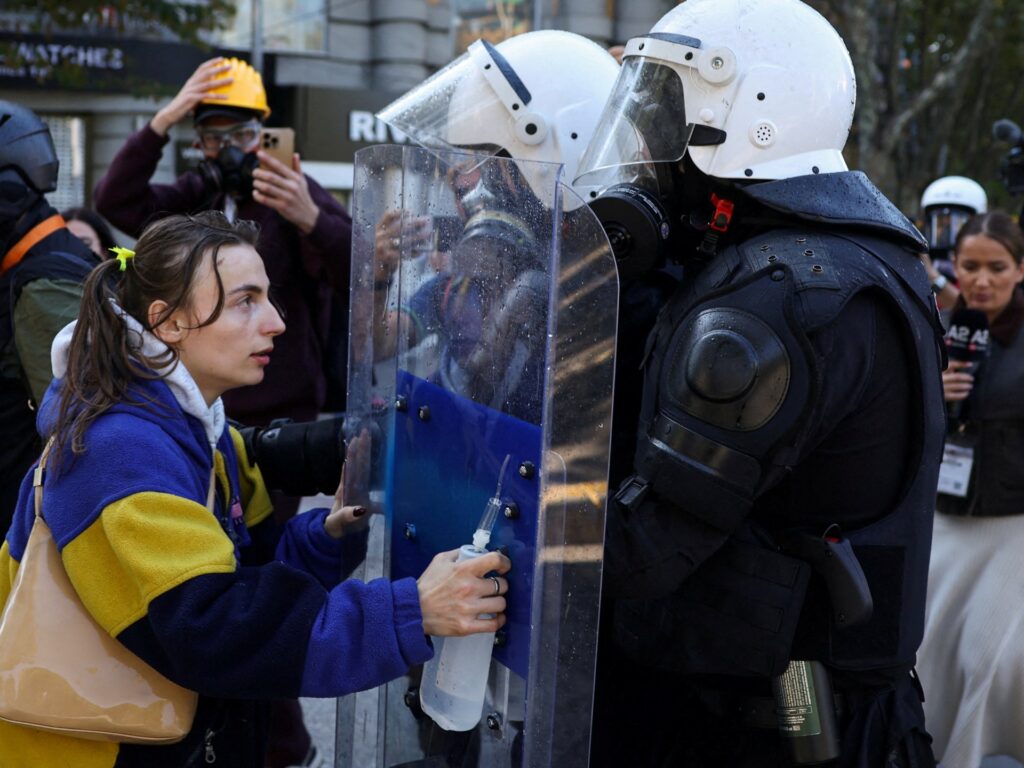
‘Horizontal revolt’: Young Albanians demand Prime Minister Rama’s resignation
For several days the streets of Tirana have been filled with anti‑government demonstrations, as thousands of young people clash with police who have used tear gas to keep protesters from breaching barricades. The unrest intensified last week when high school and university students joined the protests, citing rising tuition fees and deteriorating infrastructure.
What began in May as a focused environmental protest has quickly grown into one of the most serious political challenges facing Prime Minister Edi Rama in his more than ten‑year tenure. Analysts and journalists on the ground stress that the movement is largely decentralized and driven by youth, rather than being orchestrated by political opponents or foreign actors as the government claims.
Fatos Hakorja, editor‑in‑chief of TV Klan and Klan News, told Al Jazeera that the demonstrations have evolved organically into a broad coalition of high‑school students, university students, environmentalists and disgruntled citizens. “So far, what can be said with certainty is that the protests have been organised mainly by young people themselves,” Hakorja said. “What began as the ‘Flamingo Revolution’ gradually developed into a broader student and youth protest… There is no clear evidence that a single consolidated structure stands behind the protests.” He added that coordination happens dynamically on platforms such as WhatsApp, Telegram and Snapchat rather than through formal organisational hierarchies.
Albanian political analyst Ben Andoni echoed this view, describing the situation as “a genuine, horizontal revolt.” “The protest has turned into a rebellion for the past seven days. It was a protest before, but it has never taken on the character of a movement. If it were so, there would be a leadership group and some short‑, medium‑, and long‑term goals,” Andoni told Al Jazeera. “It is a horizontal movement, where people are mobilised by TikTok groups and social networks, but not by true cultural and political organisations. That is also a handicap or a source of pressure for Rama’s government, which seeks to negotiate, but finds no single counterpart standing in its way.”
The roots of the unrest are multifaceted, blending local grievances with a deeper frustration over governance, economic stagnation and corruption. The initial spark, dubbed the “Flamingo Revolution,” arose from opposition to luxury development projects in protected coastal areas such as Zvernec and a planned resort on Sazan Island backed by a firm linked to Jared Kushner, the son‑in‑law of former U.S. President Donald Trump. The flamingo, native to the lagoons, quickly became a symbol of resistance against what protesters see as the commodification of public land.
Environmental concerns soon merged with student anger over high tuition fees, substandard dormitories and perceived low competitiveness of the education system. Beneath these immediate triggers lies a broader structural crisis. “Problems of corruption, nepotism, and a lack of perspective are the main reasons that drove people to protest,” Andoni explained. “The protest summarised the entire range of problems that Albania has, and brought them to the doorstep of a government that has crossed lines regarding corruption, inequality, and particularly a lack of empathy for the people.” Some protesters, especially on social media, also argue that Rama places the country’s interests at the service of private, personal or foreign influences, including alleged Israeli interests. Those claims have not been proven, but they have amplified the anger of many young people and a wider segment of the population, Hakorja noted.
Rama has dismissed the allegations as conspiracy theories and labelled them manipulated disinformation spread through social media by “foreign hands,” intended to destabilise the government and undermine public institutions.
A striking feature of the uprising is the protesters’ outright rejection of both the ruling Socialist Party and the traditional opposition, including the Democratic Party led by Sali Berisha. While Rama has accused the opposition of trying to co‑opt the movement, the demonstrators continue to operate without a single recognised leader, making negotiations with the government especially difficult.