
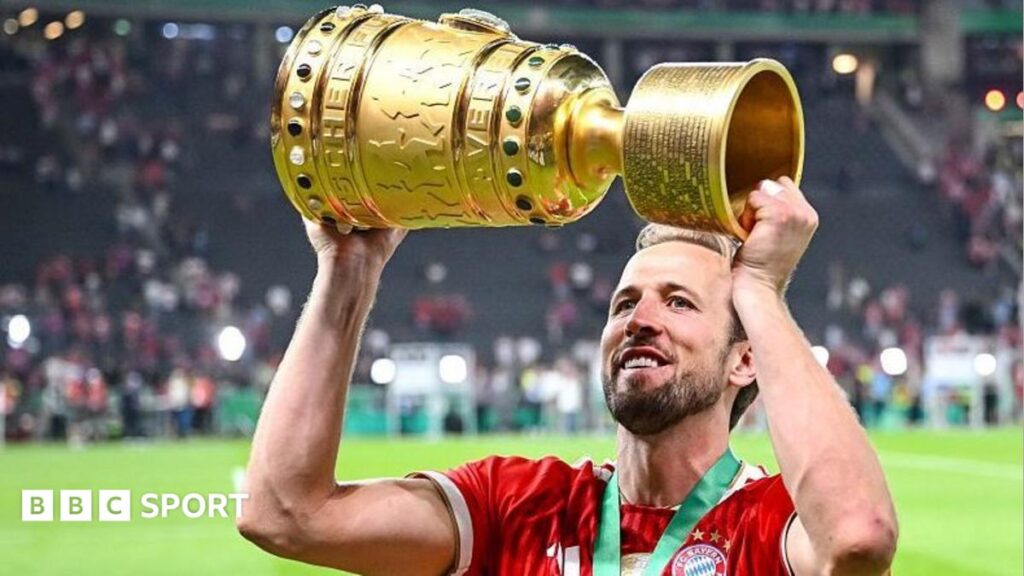
Harry Kane describes his role as one of two number 10s
Harry Kane, now 33, has taken on a deeper position in recent seasons, often collecting the ball inside his own penalty area. Despite being England’s record goalscorer and a Bayern Munich striker, he scored 73 goals last season – the highest total of his career – while playing farther from goal than ever before. When asked about this apparent contradiction, Kane smiled and said, “Until you really understand football and understand what we’ve been talking about, it’s so easy to say ‘stay high, you’re going to score’ but it doesn’t work like that.”
In a conversation about the nuances of his game, Kane explained how his professionalism shows on the training ground. He is usually among the first on the pitch, watching younger players do kick‑ups while he chats with staff. To an observer he might look like a coach, but his influence on the field makes that impression fitting. Those who know him describe him as well‑rounded and humble, both on and off the pitch.
The article notes a graphic that illustrates how dropping deep helps Kane create scoring opportunities. Although the season is just beginning, Kane is not resting on last year’s achievements. After only five days of pre‑season training, he played the full 90 minutes in Bayern Munich’s 2‑1 victory over Borussia Dortmund to claim the German Super Cup. His roaming role is physically demanding, yet data from STATSports – a company in which Kane has invested – shows that over the past six seasons his distance covered increased by 8%, high‑speed running by 22% and accelerations by 42%. Adapting to a changing tactical landscape, he has not only kept pace but stayed ahead.
Another graphic tracks the evolution of Kane’s role over the last nine years, showing his involvement in all phases of play, including defending as deep as his own box. Kane observed, “Over the last five or six years, man‑to‑man pressure has become bigger. European football is physical and top teams are trying to win the ball back high, trusting their defenders and midfielders to defend man for man to win their battles.” He added that the best teams now seek physical athletes and skillful dribblers who can thrive in one‑against‑one situations.
Although Kane is not known for dribbling and admits he is “not the fastest,” he has succeeded by using his intelligence. In the Super Cup match against Dortmund, he dropped deep to find unmarked space. When two opponents closed in, he used his strength to shrug off centre‑back Waldemar Anton, adjusted his body to the right and then flicked the ball back the other way, leaving Daniel Svensson and Jobe Bellingham wrong‑footed and opening the pitch from Bayern’s half.
A series of images shows Kane shielding the ball from Anton, adjusting his stance, moving the opposition to the right flank and cutting the ball back into open space to evade two defenders.
Earlier this year, Bayern head coach Vincent Kompany described Kane’s contribution as being 50% coaching input and 50% Kane’s own decision making. Kane said, “I think it’s partly instinct, using my football brain and getting the feeling on the pitch. If, for example, I want to drop and see if the centre‑back really wants to commit, he might commit into midfield, but is he going to commit if I drop all the way to my box?” He noted that after the first five or ten minutes he gains a sense of how the opposition will play, which then shapes his own approach.
Kane feels that his current position is best described as one of two number 10s working together. “You can double up on one side to overload, which causes the opposition centre‑backs a problem of who to mark. If they want to mark both, they’ve got to go man‑to‑man and then that leaves space for our wingers or full‑backs to run into.” This approach creates constant questions for the opposing defence and allows Bayern to exploit the gaps that appear.