
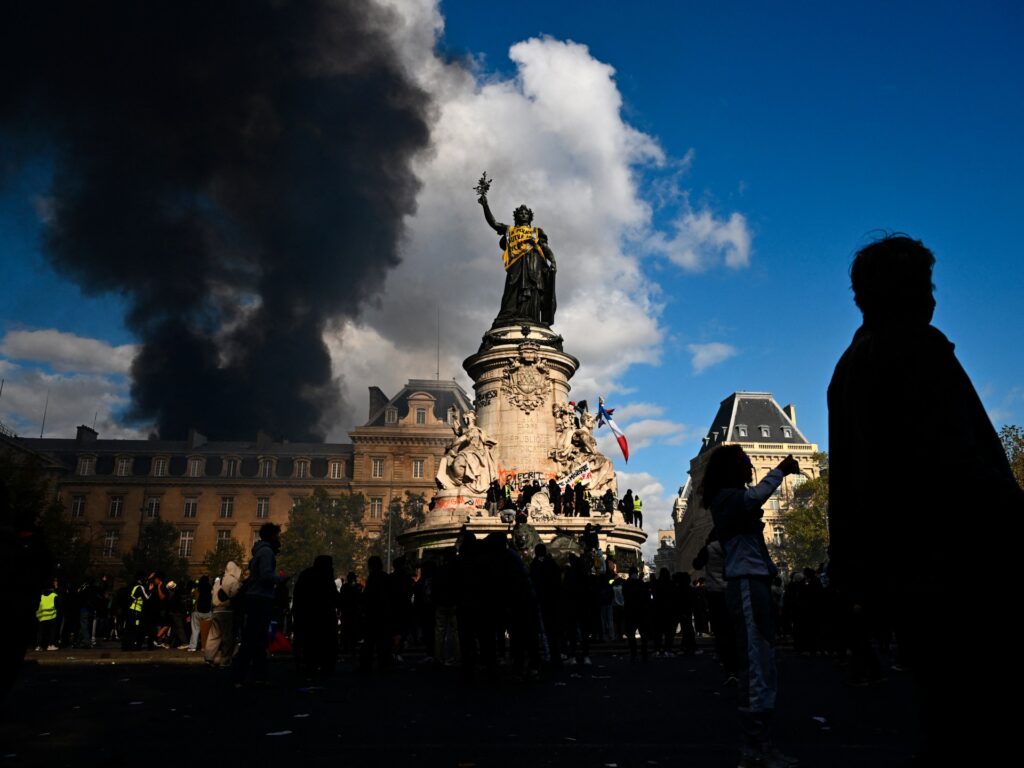
Police confront demonstrators as nationwide protests erupt across France
Hundreds of thousands took to the streets on Saturday in a wave of protests that has shaken France for more than a month. The main rally in Paris gathered around 110,000 people at Place de la République, where the marble statue of Marianne, the personification of the Republic, was draped in a yellow vest and surrounded by tear‑gas smoke. Below the monument, the faces of the allegorical figures for Liberty, Equality and Fraternity were marked with black streaks, a stark image of the turmoil in the capital.
The demonstrations began as a student movement demanding reforms in education, but quickly expanded to voice broader grievances about deteriorating public services, soaring living costs and a future that many feel is slipping out of reach. “Everyone has come together to ask the government one last time to hear us loud and clear because it is not OK what is happening,” said an unnamed high‑school student, raising her fist. “We are here because we want to take back our rights,” she added.
Support crossed class and professional lines, with nurses, human‑rights lawyers, firefighters, parents, teachers and remnants of the 2018 “yellow‑vest” protests joining the crowds. The CGT, one of France’s biggest labour unions, backed the protests, calling for higher wages and pensions, lower prices and the protection of public services that meet people’s needs. Authorities estimated that 550,000 people demonstrated across the country on Saturday.
Interviewed protesters repeatedly spoke of a system that has failed them. “Young people are anxious about their futures and their failing schools; the yellow‑vests are distressed by the exploding cost of living; and there are existential anxieties about the geopolitical situation,” said Jean Pierre, a member of the French Human Rights League. “That is why there are so many people out there; it is the result of a whole host of anxieties that people are feeling today.”
Parents also turned out. Amelie, a mother of three who declined to give her surname, said she felt it was vital to stand with the demonstrators despite the tear‑gas smell. “We will keep up the pressure to make sure someone is taking care of our children’s future,” she told Al Jazeera, standing beside her teenage daughter.
Police in full riot gear were stationed around the square. Early in the afternoon, tear‑gas canisters were fired, and by 2 p.m. (12:00 GMT) the square was packed and tensions rose. Some protesters threw fireworks at officers, set a car and a newspaper stand ablaze, and the resulting black smoke rose above the crowd. The scent of tear gas drifted through nearby streets, and the sound of stun grenades grew louder as the day went on. Coffee shops and boutiques closed, while fire‑engine sirens echoed across the city. Despite the clashes, the majority of participants continued the march toward north‑western Paris.
Violence spread to other cities. In Marseille, demonstrators broke into the town hall and looted shops; in Lyon, a tourism office was set on fire, according to local media. The Ministry of the Interior reported that at least 400 people were arrested in Paris, Marseille, Rennes, Toulouse and Angers after incidents that included attempted looting, confrontations with police, arson of street furniture and attacks on media outlets. The ministry blamed the unrest on what it described as “ultra‑left” elements.
Bruno Cautres, a researcher at the Paris‑based Center for Political Research, told Al Jazeera that Saturday’s events represented the culmination of several mobilisations driven by frustration over high taxes, a large national debt and a budget deficit that limits the government’s ability to meet public demands. “The French are asking themselves where we are going as a country and how we will get out of this budget crisis,” he said.
The protests originated in mid‑September at a high school in the Paris suburb of Créteil, where students rallied against dilapidated buildings, overcrowded classrooms, teacher shortages and what they see as a deeply unequal education system. Saturday’s gathering marked the most visible expression of that discontent to date.