
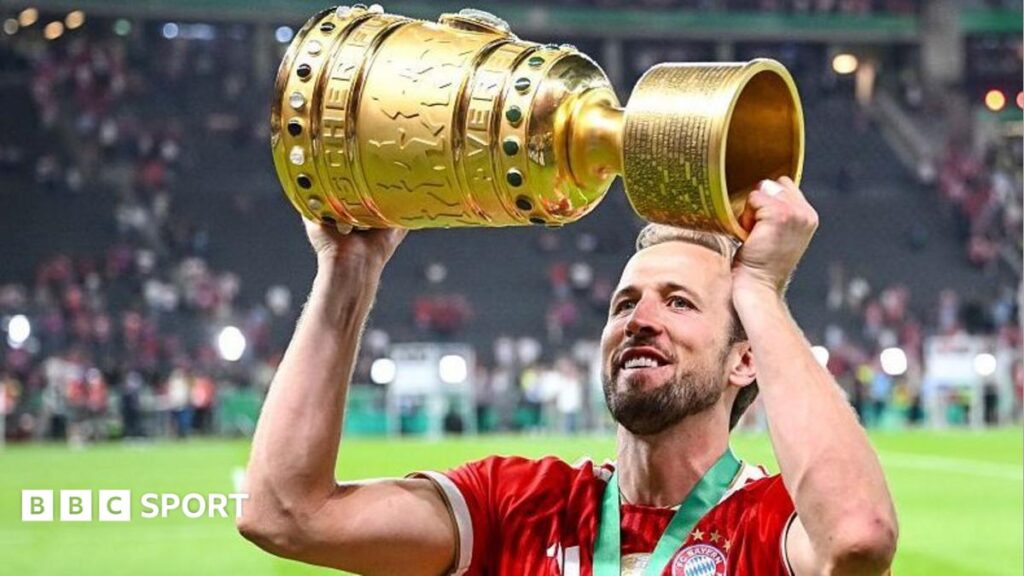
Kane says he now operates as one of two number‑10s, reflecting his evolving role
Harry Kane, now 33, has transformed his game into a more all‑encompassing one, often drifting as far back as his own penalty area to receive the ball. Observers have questioned why a player whose primary task is to score would spend so much time away from the goal, yet last season the England captain and Bayern Munich striker netted a career‑high 73 goals while playing deeper than ever before.
When I point out this apparent contradiction, Kane smiles and replies, “Until you really understand football and what we’ve been talking about, it’s easy to say ‘stay high, you’ll score,’ but it doesn’t work like that.” I sat down with him to discuss the subtleties of his play.
In training, Kane’s professionalism is evident. He is often among the first to arrive on the pitch, watching younger teammates juggle the ball while chatting with staff. From a distance he could be mistaken for a coach, a fitting impression given his on‑field responsibilities.
Those who know him describe his style as a reflection of his personality: well‑rounded and humble both on and off the field. The new season is only beginning, but Kane is not resting on his laurels. After just five days of pre‑season work, the England captain completed the full 90 minutes of Bayern’s 2‑1 victory over Borussia Dortmund to claim the German Super Cup.
His roaming role demands a high physical output, and Kane has embraced it. Data from STATSports, a company in which he holds an investment, show that over the past six seasons his distance covered, high‑speed running and accelerations have risen by 8 percent, 22 percent and 42 percent respectively. In a tactical era that has grown more physically intense, maintaining and even extending those metrics is noteworthy.
Kane notes that “over the last five or six years, man‑to‑man pressure has become bigger. European football is physical and top teams try to win the ball back high, trusting their defenders and midfielders to win their battles.” Consequently, elite clubs now seek athletes who combine physicality with the ability to beat opponents in one‑on‑one situations. While not renowned for dribbling and admitting he is “not the fastest,” Kane has carved out his own way of succeeding.
A key moment against Dortmund illustrated his approach. Dropping deep into space, he attracted two defenders. Rather than relying on speed, he used a low centre of gravity and strength to shrug off centre‑back Waldemar Anton, then subtly shifted his body to the right. This tiny adjustment allowed him to shield the ball, fool Daniel Svensson and Jobe Bellingham, and flick the ball back, opening the entire half from Bayern’s own side.
Earlier this year, Bayern manager Vincent Kompany described Kane’s role as half coached, half decided by the player himself. “It’s partly instinct, using my football brain and feeling what’s happening on the pitch,” Kane says. “If I drop and see whether the centre‑back commits, he might step into midfield, but will he if I drop all the way to my box?” He adds that after the first five or ten minutes he reads the opposition’s plan, which then shapes his positioning.
In Bayern’s early clash with Arsenal, Kane dropped into a zone usually occupied by centre‑backs, prompting William Saliba to follow him and leaving space higher up the field. At the club, there is a shared understanding that such rotations, though they may look random, have a purpose. Kane enjoys more freedom than most, sitting at the heart of that system.
“I feel my position now is as one of two number‑10s, and we work together,” he explains. “You can double up on one side to overload, which forces the opposition centre‑backs to choose who to mark. If they try to mark both, they have to go man‑to‑man, opening space for our wingers or full‑backs.” This tactical flexibility continues to define Kane’s evolution and his impact on the game.