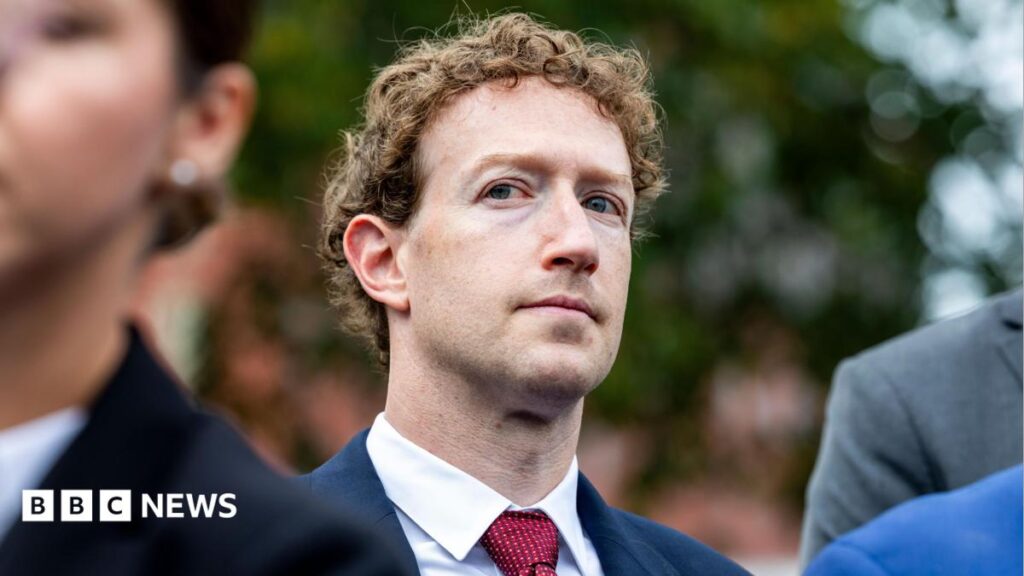
Meta slapped with $25 billion penalty for misleading users about data privacy
A New Mexico judge on Wednesday ordered Meta, the parent company of Facebook, Instagram and WhatsApp, to pay a $25 billion fine – the largest ever imposed on the tech giant – after a two‑week trial earlier this year concluded that the company had repeatedly deceived the public about how it handled Facebook user data. The judge said the falsehoods “reach the heart of Facebook’s core business practices.”
Meta’s lead counsel, CJ Mahoney, warned that the decision makes it “all but impossible to do business in the state of New Mexico.” The company plans to appeal the ruling, a move Mahoney said it expects to win.
The penalty eclipses all previous fines against Meta, which has already settled or paid several large judgments this year, including an $18 billion settlement with California over child‑safety concerns.
New Mexico’s lawsuit originated from the company’s role, then still operating as Facebook, in the Cambridge Analytica scandal. The political‑consulting firm harvested data from millions of Facebook users for campaigns, including work tied to the 2016 U.S. presidential election that brought Donald Trump to the White House.
State prosecutors also accused Meta of deliberately misleading the public about the benefits it derived from content that contained hate speech and about how it enforced related policies. A jury found the company had indeed misled the public on those points, a claim Meta continues to dispute. Mahoney characterized the suit as an attempt to “impose a tax on speech to enforce new rules for what people can say online.”
The case focused on statements by Meta executives that user data was never shared with or accessed by third parties without permission – assertions that were later shown to be false. Lawyers argued that the entire New Mexico population, roughly two million people, was affected by the company’s deceptive practices. The jury concluded Meta had violated state law more than 40 million times.
New Mexico Attorney General Raúl Torrez said, “For too long, powerful technology companies have operated as though their size and influence put them beyond the reach of the law. Today’s result makes clear that no corporation is too powerful to be held accountable.”
State lawyers had originally sought up to $40 billion in penalties. Meta contended that any fine beyond $3.4 billion would be unconstitutional. Judge Francis Mathew, however, imposed a $25 billion sanction, roughly equal to Meta’s quarterly profit. He described the violations as “willful” and spanning more than 11 years, from 2010 to 2021, and noted that internal communications – including those involving CEO Mark Zuckerberg – were “designed to mislead the public.” While the calculated penalty for the thousands of state‑law breaches reached $219 billion, the judge reduced it to the $25 billion figure.
The decision follows a $5 billion fine levied by the U.S. Federal Trade Commission in 2019 over Meta’s data‑privacy practices. Earlier this year the company also faced a $567 million child‑safety ruling and a nearly $1 billion penalty for misleading the public about the safety of its platforms for children. In that case, the presiding judge likened Meta’s impact to that of an industrial polluter, describing the “pollution” as psychological harm and sexual exploitation of minors.
Despite the mounting legal costs, Meta is pouring billions into artificial‑intelligence development. Zuckerberg told analysts that the company’s consumer‑focused AI tool, Muse, already serves 10 million users, and that scaling the service to billions is both the company’s mission and its strategy. Meta expects to spend between $135 billion and $145 billion on AI projects this year, a level of investment that pushed its cash flow into negative territory by more than $2 billion – the first such loss since the firm went public 14 years ago.
Revenue for the July‑September quarter rose 26 percent year over year to $64.5 billion, and net profit tripled to $9.8 billion. CFO Susan Li announced a stock split that will give existing shareholders one additional non‑voting share, a move intended to provide greater financial flexibility as the company continues to fund its AI ambitions.