
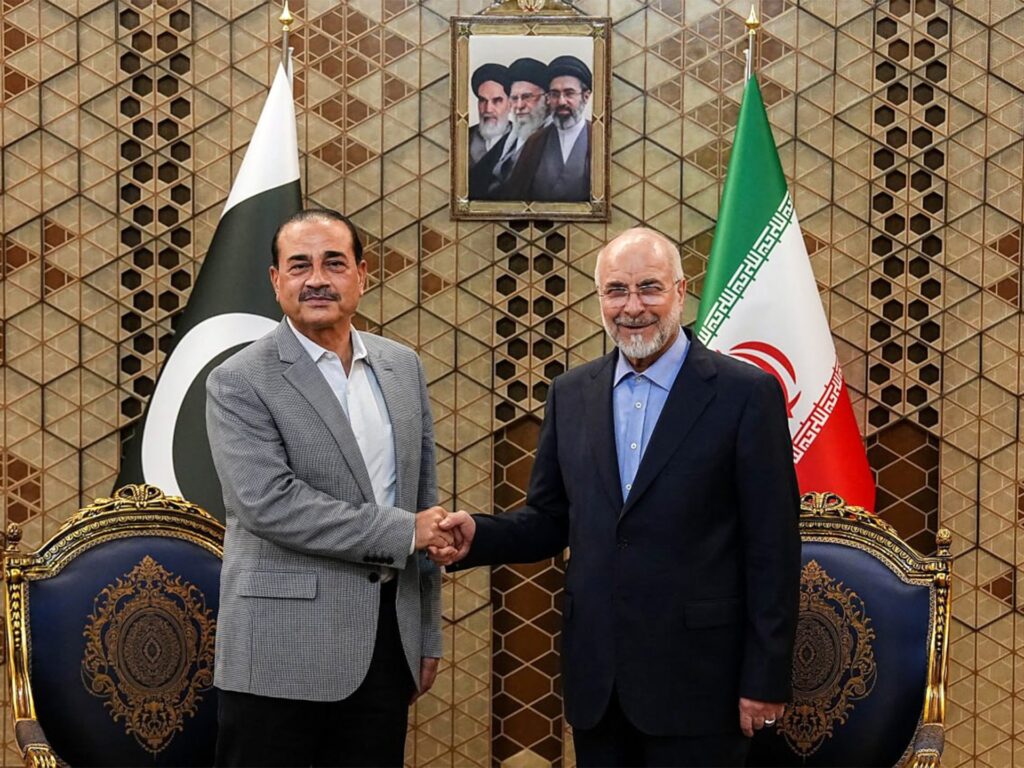
Pakistan’s army chief in Tehran seeks diplomatic path to avert fresh US‑Iran clash
Pakistan’s top military commander, Field Marshal Asim Munir, landed in Tehran on Tuesday evening for a series of meetings with Iranian officials, as diplomatic activity intensifies to stop a new round of hostilities involving the United States and Israel. This is Munir’s fifth visit to Iran since the cease‑fire between Tehran and Washington was arranged in April with Islamabad’s help. Pakistan’s interior minister, Mohsin Naqvi, is traveling with the army chief, according to the Iranian state news agency IRNA, which says Munir will first see foreign minister Abbas Araghchi.
The trip follows Russian foreign minister Sergey Lavrov’s talks in Tehran on Monday, his first visit there since the US‑Israel conflict with Iran began in February. Lavrov met Araghchi and President Masoud Pezeshkian to discuss the war, the Strait of Hormuz and steps to end the fighting. “The timing of Munir’s visit, coming right after Lavrov’s presence in Tehran, suggests that Iran wants to keep several diplomatic channels open rather than rely on a single mediator,” said Seyed Mojtaba Jalazadeh, a foreign‑policy analyst based in Tehran.
Munir’s arrival also occurs amid warnings from some observers that US President Donald Trump may be gearing up for renewed combat with Iran. Trump turned down an Iranian offer to end the war on September 26 and has since ordered an additional aircraft carrier to the region, expected to arrive by late November. He has voiced strong support for Israeli Prime Minister Benjamin Netanyahu ahead of Israel’s October 27 election, linking their shared goal of confronting Iran. Trump has hinted that if Netanyahu does not win, the United States would have to act against Iran on its own.
Analysts say these developments increase the pressure on diplomatic channels to avoid escalation. In recent weeks Qatar has become a key conduit for proposals between Washington and Tehran. Andreas Krieg, an associate professor of security studies at King’s College London, told Al Jazeera that while Doha handles much of the detailed negotiating, it still values Islamabad’s access to both capitals. “Pakistan offers political access, particularly through Field Marshal Asim Munir, while Qatar does much of the detailed negotiating,” he said.
Since the US and Israel began striking Iran on February 28, Pakistan has positioned itself as a mediator. The Islamabad‑brokered cease‑fire on April 8 was followed by the highest‑level direct talks between Washington and Tehran since 1979. In June the two sides signed a 14‑point memorandum of understanding (MoU) that called for the US to lift its naval blockade within 30 days, for the Strait of Hormuz to be reopened, and for roughly $24 billion in frozen Iranian assets to be released in phases over 60 days, alongside talks on Iran’s nuclear programme. That timeline ran out in mid‑August without an extension; Iran says the United States failed to meet its commitments and has kept the Strait closed, demanding that Washington first lift the blockade.
Pakistan’s foreign ministry continues to cite the MoU as a framework for ongoing discussions. “The Islamabad MoU is already in place, and some of the points currently under discussion are fully aligned with it,” spokesman Sajjad Haider Khan told a briefing on October 9. Deputy prime minister and foreign minister Ishaq Dar said on October 2 that Iran’s seven‑day plan was drawn from the MoU.
Experts differ on whether the agreement can still serve as a negotiating basis. Umer Karim, an associate fellow at the King Faisal Centre for Research and Islamic Studies in Riyadh, told Al Jazeera that a new mechanism may be needed to restart talks. Krieg described the MoU as “politically alive but operationally dead,” noting that the circumstances of its signing have fundamentally changed. In contrast, Muhammad Faisal, a South Asia security researcher at the University of Technology Sydney, argued that the MoU remains usable even in a deteriorated security environment, providing a minimum benchmark for addressing maritime access, sanctions relief and nuclear negotiations.
In parallel, Pakistan, Saudi Arabia and Turkey have signed the Mecca Joint declaration, signaling deeper cooperation as regional tensions rise.