
Losing Cuba, the Global Trickster
By Mario Reinaldo Machado, Lecturer at Dartmouth College
Published on 19 Oct 2016
Cuba has once again become a focus of U.S. attention. The American operation in Venezuela earlier this year is widely seen as a prelude to a similar move against the Caribbean island. Recent reports have documented U.S. military activity in the vicinity, while officials in Washington have repeatedly declared that they want “Cuba to be free.” The timing and method of any potential strike remain uncertain, but the signs suggest that the Cuban Revolution could be approaching its end. That possibility alone warrants a pause to consider the disproportionate influence a nation of ten million has wielded on the world stage.
When one thinks of Cuba’s role in global politics, the figure of Eshu from Cuban Santería comes to mind. Eshu, a powerful spirit rooted in Yoruba tradition, serves as a messenger, guardian of crossroads, and bridge between past and future. In folklore, he appears as a mischievous elder whose tricks teach humility and morality. As a classic trickster archetype, Eshu challenges norms, overturns power structures, and uncovers hidden truths. The comparison fits Cuba well, positioning the island as a trickster that has both forced open debates about the world we might aspire to and held the United States accountable, sometimes prompting the larger power to act more responsibly, however reluctantly.
The pattern began early in the revolution. In September 1960, a year after seizing power in Havana, Fidel Castro traveled to New York to address the United Nations General Assembly. Concerned about his anti‑imperialist stance, the Cold War‑obsessed U.S. government pressured several prominent hotels to deny service to Castro and his delegation. Undeterred, the Cubans found accommodation at the Hotel Theresa in Harlem. Photographers and television crews swarmed the venue, turning the episode into a media sensation. Castro seized the moment to draw parallels between the treatment of his delegation and the discrimination faced by Black Americans in the segregated South. The comparison struck a chord amid the burgeoning civil‑rights movement, highlighting an uncomfortable contrast in a liberal northern city rather than the Jim Crow South. This was the first of many instances in which Cuba, as a trickster, would make its mark.
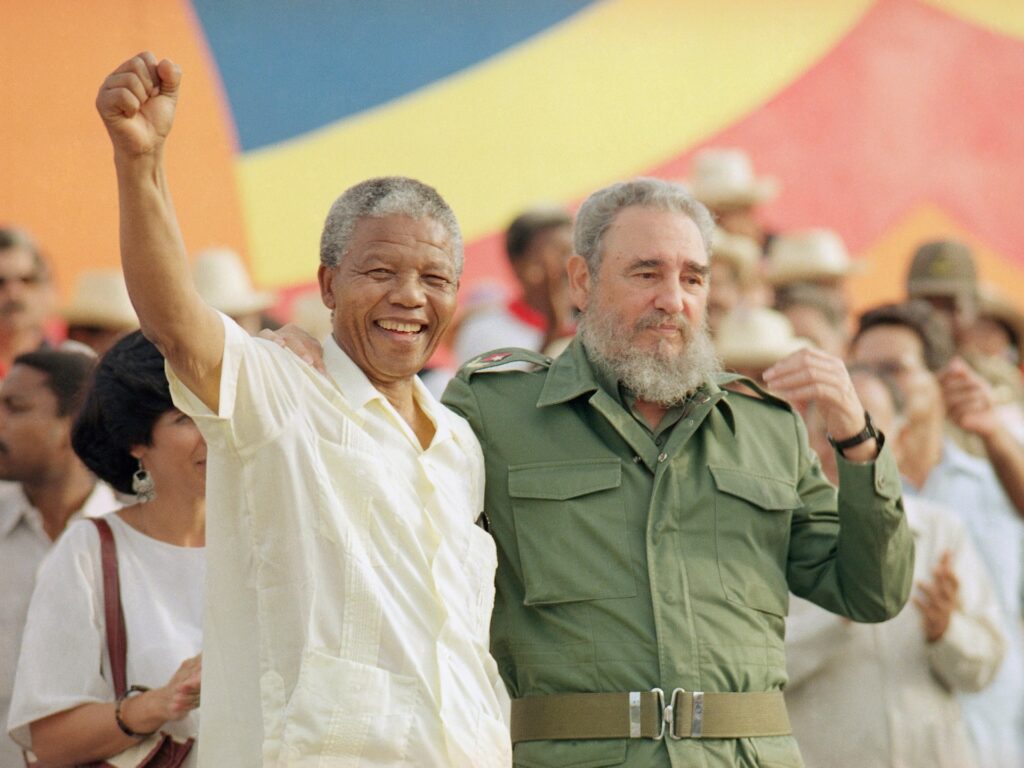
In the years that followed, the revolutionary government built a program of Cuban Internationalism that directly challenged U.S. soft‑power initiatives such as the Peace Corps and USAID. Cuba dispatched up to four hundred thousand doctors, along with engineers, agricultural technicians and other professionals, to 164 nations. This material solidarity earned the island deep affection across the Global South, from Venezuela and South Africa to Vietnam, where figures like Castro and Che Guevara sit alongside national heroes such as Simón Bolívar, Nelson Mandela and Ho Chi Minh. In those same countries, American leaders are often remembered in far less flattering terms.
Cuba’s trickster reputation is reinforced by several notable actions. The most famous is the decisive defeat of the Bay of Pigs invasion, an operation carried out by Cuban exiles but funded and supported by the CIA. The revolution also backed the Palestinian liberation movement and the anti‑apartheid struggle, even as the United States provided diplomatic cover and military aid to Israel and the apartheid regime in South Africa. From 1975 to 1991, more than three hundred thousand Cuban soldiers fought alongside Angolan forces in a proxy conflict with the United States. Known as Operation Carlota, the campaign helped free Angola and neighboring Namibia and contributed to the collapse of South African apartheid. Former South African President Nelson Mandela later said that Cuba’s intervention in Angola “destroyed the myth of the invincibility of the white oppressor.”
Castro himself embodied the spirit of Eshu. He reportedly survived more than six hundred assassination attempts and died of natural causes at the age of ninety. Cuba has also repeatedly disproved the “third‑world” label often applied to it, achieving higher literacy rates, lower infant mortality and longer life expectancy than the United States at various points in its revolutionary history.
Perhaps the most striking testament to the revolution’s resilience is its survival under the world’s longest economic embargo. The United States has maintained a severe trade blockade for over sixty years, intensifying it after the Soviet Union’s collapse when Cuba faced a deep economic crisis. Despite relentless pressure, the revolution endured the 1990s by diversifying and liberalising the economy and by leaning on its well‑established internationalist network in the Global South. In the process, Cuba also managed a nationwide sustainable agricultural transformation, a remarkable achievement for any nation and one that reflects the island’s enduring capacity for adaptation.