
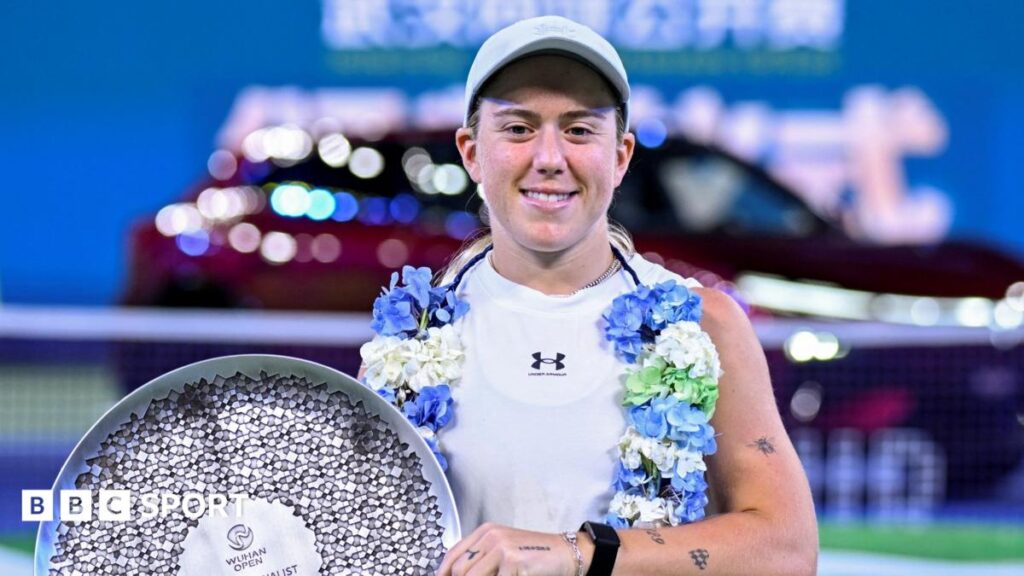
British No. 1 Sonay Kartal stages stunning comeback
Sonay Kartal, 24, has risen to the top of the British rankings for the first time after a dramatic week at the Wuhan Open, where she reached the final in only her third tournament back from a serious back injury. Six months earlier the Briton was unable to stand upright without severe pain, a consequence of a stress fracture that left her bedridden for weeks. Although the fracture eventually healed, her path to full fitness required careful rehabilitation and a great deal of patience.
Kartal did not compete again until just under a month ago. Reflecting on her early recovery, she said, “In the first month or so, I was at home in bed – sometimes I had good days but there were also bad days where I wasn’t really able to walk without some form of pain. It was a slow process and it makes you think you do take everyday things for granted a bit.”
Her run in Wuhan, a WTA 1000 event that sits just below the Grand Slams in prestige, was nothing short of extraordinary. She defeated a string of high‑profile opponents, including current top‑10 players and former Grand Slam champions, before falling to this year’s French Open runner‑up, Maja Chwalinska, in the final. The loss, which came after a set and a break, was a bitter end to an otherwise historic week.
When the back problem struck at Indian Wells in March, Kartal was ranked 54 in the world. She entered Wuhan using a protected ranking, a provision that allows players who have been out for six months or more to compete based on their pre‑injury position. The runner‑up prize of 650 points catapulted her from 170th to 49th, putting her within striking distance of her career‑high ranking of 44, achieved in July 2025 after a Wimbledon round of 16 appearance. Her rapid ascent demonstrates the intended purpose of the WTA’s special ranking rule, giving players a fair chance to rebuild after a forced layoff.
Having reclaimed a top‑50 spot after only ten matches, Kartal will no longer need to rely on a protected ranking to enter events such as the Australian Open, giving her more flexibility in planning her schedule. She withdrew from the Japan Open in Osaka on Monday, where she was slated to play her first‑round match on Tuesday, after saying her goal for the Asian swing was to defend the points she earned last year and make the protected ranking worthwhile. “I think I’ve gone above and beyond that. The goal has been achieved this week and I’m in a good spot for the rest of the year and next year,” she explained, adding that she had also secured two wins at the China Open in Beijing.
Kartal’s resurgence arrives at a time when British women have struggled at the majors. In 2026, with Kartal missing three of the four Grand Slams, no British female player advanced beyond the second round. Throughout her career she has only reached the third round at Wimbledon in 2024 and a further stage the following year, but her performance in Wuhan shows she can compete at the highest level. She is the first British player to contest a WTA 1000 final since Johanna Konta in 2019, and her result is the best by a British woman since Emma Raducanu’s US Open triumph in 2021.
Together with Arthur Fery’s surprise run to the Wimbledon semi‑finals, Kartal’s achievements provide a much‑needed boost for British tennis fans. While she does not possess the height and raw power of many top players, her consistent baseline game, athleticism and composure have already taken her into the top‑50 bracket. Maintaining fitness will be crucial moving forward. Kartal confirms the stress fracture has fully healed, and her team says she “worked her socks off, 9‑5 all the time” during rehab to ensure she could return ready to compete.
After receiving the runner‑up trophy, Kartal thanked her coach Ben Reeves, fitness coach Ian Aylward and physio Dani Gillanders. “If it wasn’t for them I wouldn’t be here,” she said. “It makes it even better that the three people who helped me get back to fitness and fixed my back are with me. It’s been a special week for all of us.”