CDA Seals Fazlur Rehman’s Islamabad Residence as JUI-F Standoff Deepens
The Capital Development Authority sealed the Islamabad residence of Jamiat Ulema-e-Islam-Fazl chief Maulana Fazlur Rehman on Saturday morning, and police arrested his son Maulana Asjad Mehmood during the operation. It is the sharpest escalation yet in a confrontation that has already put hundreds of party workers behind bars across the country.
Why the house was sealed
The CDA order, dated 27 November, cancels the allotment of House No. 7, Street 83, Sector G-6/4, a 1,200 square yard property whose title was transferred to Amanullah, son of Muhammad Younus. Government departments told the authority that NADRA had identified Amanullah as a foreign national and cancelled his Pakistani CNIC. NADRA reported discrepancies in the family record, including two CNICs in the name of his late father. The authority summoned Amanullah on 26 November, he did not appear, and the CDA then cancelled the change of title and ordered the property sealed, citing its Property Manual and Section 3 of the Foreigners Act, 1946. Police blocked the roads around the house, removed family members, and took Asjad Mehmood into custody for what officials called resistance during the sealing. The JUI-F spokesman confirmed the arrest.
A week of arrests on the streets
The sealing caps a week in which the JUI-F took to the streets and the state answered with arrests. On Friday, workers protested across Khyber Pakhtunkhwa, Balochistan, Sindh and Punjab against what the party calls the detention of its chief and the restrictions on his movement. Police in Shangla arrested more than 100 leaders and workers after sit-ins on the Karakoram Highway. In Malakand, 38 workers were in custody, and 32 were arrested at the Chakdara Bridge checkpoint for blocking the motorway. An FIR in Peshawar named 16 leaders over the M-1 motorway blockade, with more than 22 arrested. In Balochistan, the party’s provincial emir, Senator Maulana Abdul Wasay, and opposition leader Mir Younas Aziz Zehri were placed under house arrest. In Sindh, workers blocked highways at Baberloi bypass and other points, despite Section 144 bans on gatherings in several districts. On Thursday, authorities barred Fazl and eight other party leaders from entering Sargodha for 30 days, where the party had planned a rally. Fazl claimed in a video message that he had been arrested near Lahore, but Lahore police chief Bilal Siddique Kamyana denied it, saying he had only been stuck in traffic.
What the standoff is really about
The sealing reads as a property matter, written in the language of allotments, CNICs and the Foreigners Act. In practice, it lands in the middle of a political fight over governor’s rule in Khyber Pakhtunkhwa, which protesters in Mohmand named as their grievance. The pattern is familiar: administrative levers, a property file here, a NAB summons there, used against a leader mobilising on the streets. NAB has also summoned Fazl’s other son, former communications minister Asad Mahmood, over alleged irregularities in 4,252 appointments at Pakistan Post during his 2022-23 tenure. The question now is whether the JUI-F answers with a bigger protest call or takes the sealing to court, where the CDA must defend a cancellation built on a CNIC that NADRA says was wrongly issued. Either way, the house in G-6 has become the newest symbol of a standoff that neither side looks ready to end.
What to watch next
First, whether Asjad Mehmood is released quickly or charged, and whether the family challenges the sealing in court. Second, whether Fazl escalates the protest call or pauses to fight the property case. Third, what the NAB proceedings against Asad Mahmood produce, and whether more administrative actions follow.
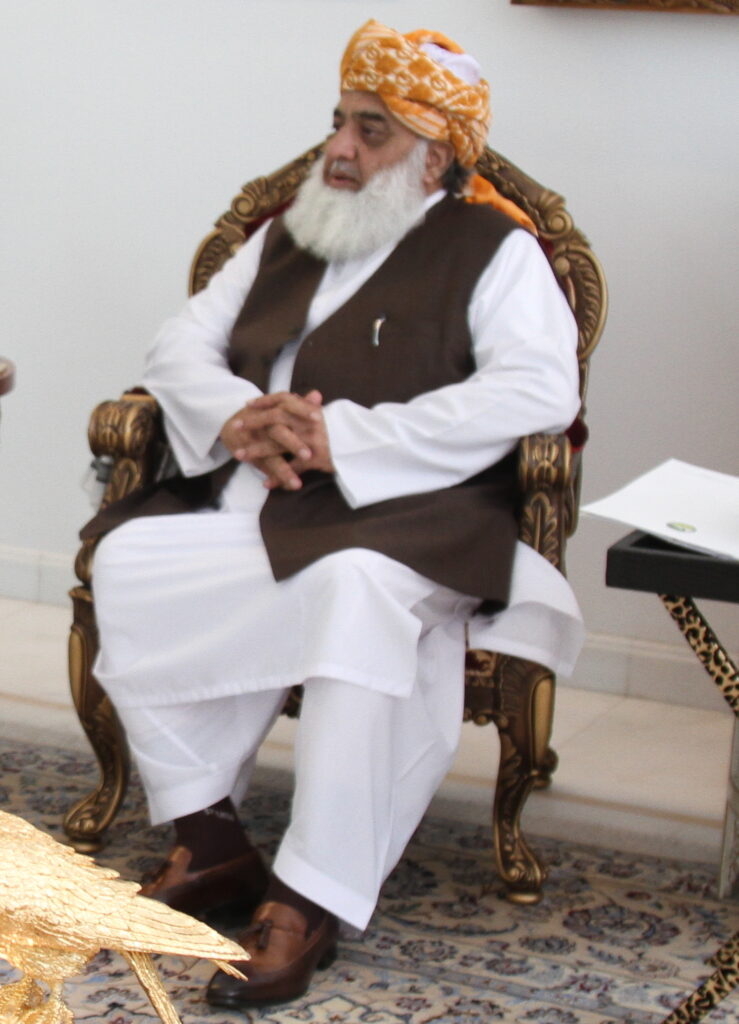
Photo: Maulana Fazlur Rehman in July 2016. Credit: Wikimedia Commons.
Sources: Dawn; Dawn; ARY News; The News; The Nation.